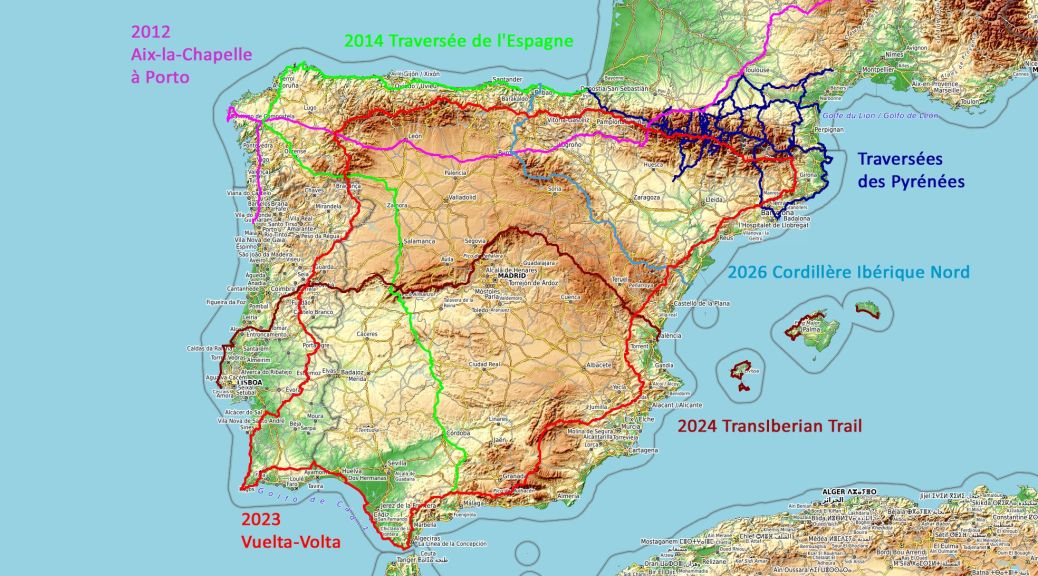
The way, useful information, daily stages, GPS tracks of a complete tour of the Iberian Peninsula by foot. 4700km with 180000m of elevation gain linking Via Algarviana, Rota Vicentina, Alta Vía Cantábrica, GR11, GR7… Mountains, sea, villages, historical sites. A wonderful tour very varied and almost entirely off-road.
Other long distance hikes in the Iberian Peninsula :
- In 2012, from Aachen to Compostela then Porto via the Camino Frances and the Camino Portuguese.
- In 2014, the hike through Spain from Tarifa to Punta Estaca de Bares (northernmost point of the Iberian Peninsula) and to the French border, mainly following caminos.
- In 2024, the TransIberian Trail, a east to west hike through the Iberian Peninsula.
- North Iberian Cordillera. In 2026, during my long distance hike “The Six Seas” from the Basque Country to the Black Sea
- See also the hikes through Pyrenees.
Vuelta-volta : the way
For long distance hike lovers, this way has the exceptional characteristic of being able to be walked in one go. For such a long hike, 4700km, it is rare. Starting in the south of Spain in spring, you’ll be in the Cantabrian Mountains and the Pyrenees in summer to finish going down at the beginning of autumn and hike through Sierra Nevada before winter. The way follows and connects several long trails : Via Algarviana, Rota Vicentina, GR7, GR11, Alta Vía Cantábrica… and also crosses 5 national parks and a large number of natural parks. The landscapes are very varied with the ocean, the high mountains, beautiful villages, hills, canyons… There are very few parts on asphalt and many beautiful paths.
Of these 4700km, previous years, I hiked six hundred. I therefore walked 4100km in 2023 as a “flip-flop”. Once in the Cantabrian Mountains, at the end of April, I went down to Andalusia to hike through Sierra Nevada and to go up towards Catalonia to finish with the Pyrenees and the Cantabrian Mountains in summer.
The way includes four very different parts:
– From Tarifa to the Vicentina coast, mostly along the Atlantic with almost no elevation gain. 1 month hiking, 700 kilometers with the Costa de la Luz in Andalusia then in Portugal, the Via Algarviana inland, and after Cape São Vicente, the southwestern end of the European continent, the Rota Vicentina (Fishermen’s Trail).
– Hike through inland Portugal. 1 month hiking, 900 kilometres. There are plenty marked trails with beautiful landscapes such as Serra da Estrela (and the Torre, the highest point in mainland Portugal at 1993m) or Douro Valley and many historic villages and towns: Évora, Estremoz, Marvão, Trancoso, Bragança…
– The GR7 from Andalusia to the Pyrenees. I already hiked in 2014 from Tarifa to Antequera; I started from the Torcal of Antequera then hiked through Sierra Nevada and up to the highest point of the Iberian Peninsula, the Mulhacén at 3479m. After the beautiful Sierra de Castril, I went in the Valencia region to resume the GR7 where I stopped last year. This part goes through wild mid-mountain regions with nice paths and typical villages. I hiked about 1000km to finish my GR7.
– The mountain with the Pyrenees and Cantabrian Mountains. 1400km, 75000m of elevation gain and almost two months. In the Pyrenees, I chose to stay away from the border ridge to discover less known parts of the chain with for example the Serra del Cadí or south part of the Encantats, Tendeñera, Castillo de Acher. I also climbed the three highest peaks of Pyrenees : Aneto, Posets and Monte Perdido. In the Cantabrian Mountains, I more or less followed the watershed line but with some adaptations of the Alta Ruta Cantábrica with from Potes, a hook in the Picos de Europa. This hike through Pyrenees and Cantabrian Mountains is superb and is one of the most beautiful mountain routes.
See the details of the stages, GPS tracks as well as all the information on the logistics (supplies, accommodation, water…) in the pages devoted to each part of my walk.
Tarifa-Alcoutim
Via Algarviana
Rota Vicentina
Inland Portugal
GR7-Spain
Pyrenees – south side
Cantabrian Mountains
For the every day diary (in french), see the Vuelta-volta récit page.
All the pictures
By clicking the image below

The trails in Spain
Map of long distance (GR) trails in Spain

Map of caminos in Spain

My equipment
Since 2017 and the Appalachian Trail, I have almost the same equipment. To see the explanation of my main choices, see the Italy 2021 introduction page. I had to change some equipment and bought some that were a bit heavier than the old ones. In return, I do not take certain elements of autonomy (solar panel, filtering water bottle, gas cartridge of lesser capacity) that I had during my hike through Caucasus and Turkey. My basic weight excluding water and food remains around 7.5 kg. I even plan to walk with a little less than 7kg during the first weeks (few bivouacs and cold temperatures).

 Thru hikes in Europe, Asia, USA...