Hiking through Balkans : the way, the daily stages, advices, accommodation, GPS tracks..
Hiking through Balkans
Three long distance walks in the Balkans:
-
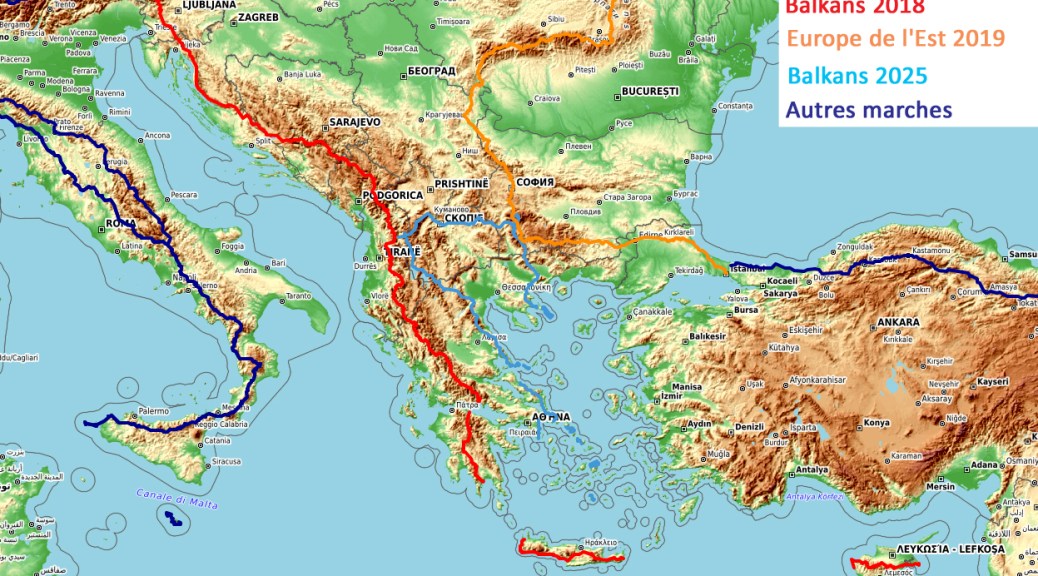
- 2018: hiking from the eastern coast of Cyprus to Slovenia via Crete, Peloponnese, Central Greece (with the Pindus mountains), Albania and Via Dinarica. I then followed to the Dolomites on Via Alpina.
- 2019: hiking through Eastern Europe from Istanbul to Italy via Bulgaria (Rhodopes, Pirin, Rila and the Balkan mountains) before continuing to Serbia and Romania via the Carpathians.
- 2025: hiking in Aegean Greece starting with the Cyclades, Euboea, the Sporades, Mount Athos then walking through Macedonia (Greek, Bulgarian and Northern).
Hiking through Balkans in 2018
4 months hiking, around 3450 kilometers through nine countries (Cyprus, Greece, Albania, Montenegro, Bosnia-Herzegovina, Croatia, Slovenia, Austria, Italy). A way through mountains with 160 kilometers of ascents but also a way through history between greek and roman worlds, Eastern and Western Europe, Austria-Hungary and Ottoman empires, at the border of catholics, orthodox and muslims areas.
I started at Cape Greco to hiked through Cyprus and then through Crete. From the south of Peloponnese, I hiked the peninsula and then through Central Greece. This part is quite isolated. The mountains often exceed 2,000 meters altitude and are still wild. But whatever the area, in all Greece, I found kindness and hospitality.
What to say about Albania? Meeting Albanians is a great moment of this part. The country has long remained closed to tourism. Relationships are still authentic. Albania is also great with beautiful mountain and countryside scenery.
Entry into Montenegro marked the return to the western world. A path, over 1000 kilometers, the Via Dinarica, exists. It brought me to Slovenia via Bosnia and Herzegovina and Croatia.
To see detailed information (accomodation, resupply…), GPS tracks, go the each specific pages :
Hiking through Eastern Europe in 2019
From Istanbul, I hiked through Thrace, the European part of Turkey, with a superb way along the Black Sea coast and then through Edirne with its splendid mosque. Before arriving in Bulgaria, I crossed a corner of Greece. Bulgaria is very beautiful with varied landscapes, Alpine massifs (Pirin, Rila), others easier (Rhodopes, Balkans), Turkish and Pomaks villages, monasteries and Orthodox churches… all with many paths. I walked nearly 800 kilometers in this country before continuing in Serbia to go up the Carpathian mountain range through beautiful mid-mountain landscapes and reach Romania where the Danube crosses the Carpathians : the spectacular Iron Gates gorges.
To see detailed information (accomodation, resupply…), GPS tracks, go the each specific pages :
Aegean Greece and Macedonia in 2025
In 2025, walk in Aegean Greece with the Cyclades (Santorini, Naxos, Tinos and Andros), Euboea, the Sporades (Skopelos and Skiathos), the Pelion peninsula up to the foot of Mount Olympus and Mount Athos.
From Mount Athos, the way continues towards the Bulgarian border to hike through the highest massifs of the country, first the Pirin and its highest point, the Vikhren peak at 2914m then towards the north with a loop in the Rila before reaching the border.
In North Macedonia, I walked east to west via the Osogovo massif then the plain in the center of the country. I followed westward hiking through the Šar mountains at the border with Kosovo then south at the Albanian border with the Korab massif, the highest point of the country at 2753m above sea level. After walking along the shores of Ohrid lake, the way ends in Greece with Mount Olympus.
To see detailed information (accomodation, resupply…), GPS tracks, go the each specific pages :
My equipment for 2025
Since 2017 and the Appalachian Trail, I have almost the same equipment. For the reasons for my main choices, see the introduction page of Italy.
Compared to 2024, the main change is to leave my camera. Until now, I wanted to benefit from the zooms of the cameras and also avoid using the phone too regularly and take the risk of either breaking it or just being on battery (it is first and foremost a safety tool to call in case of need and to guide myself). The evolution of zooms on phones convinced me of this choice. In return, I upgraded my charging tools. The overall result of these choices is a gain of about 250g.
Phone: Google Pixel 8 Pro. For waterproofing, it is rated IP68. It will also be in a case (just cut at the lenses) attached to the backpack (to prevent it from falling when I take a photo). I chose this model for the quality of the photos and also for the possibility of emergency satellite message that is operational for the countries of European Union.
Solar panel: I abandoned the models used until now (Tomtop…) because their performance and durability did not satisfy me. I switched to the X-Moove ETFE 6W. On the tests carried out, it charges in 5W. Weight of the panel: 150g.
Powerbank: I have a Sofirn HS 41 headlamp that works with 21700 batteries and can be a powerbank for the phone. I tested it with two normally 6000mAh batteries and it gives me 3200mAh on my phone. I was disappointed by this result, I expected more… Weight of the headlamp with its 21700 battery: 150g.
So I hope with my phone (5050mAh battery) + headlamp (3200mAh) + solar panel to be able to manage the use of the phone without restricting myself in photos knowing that I am not a fan of long periods of autonomy in the mountains either.
My base weight (excluding carry, water and food) is 7.3kg. It is still a kilo less than in 2017 for the Appalachian Trail!

 Thru hikes in Europe, Asia, USA...