The way, accomodation, resupply, daily stages, GPS track of the hike north-south through Pyrenees from Lourdes to Ordesa on wild paths (especially on the Spanish side).
Lourdes to Ordesa
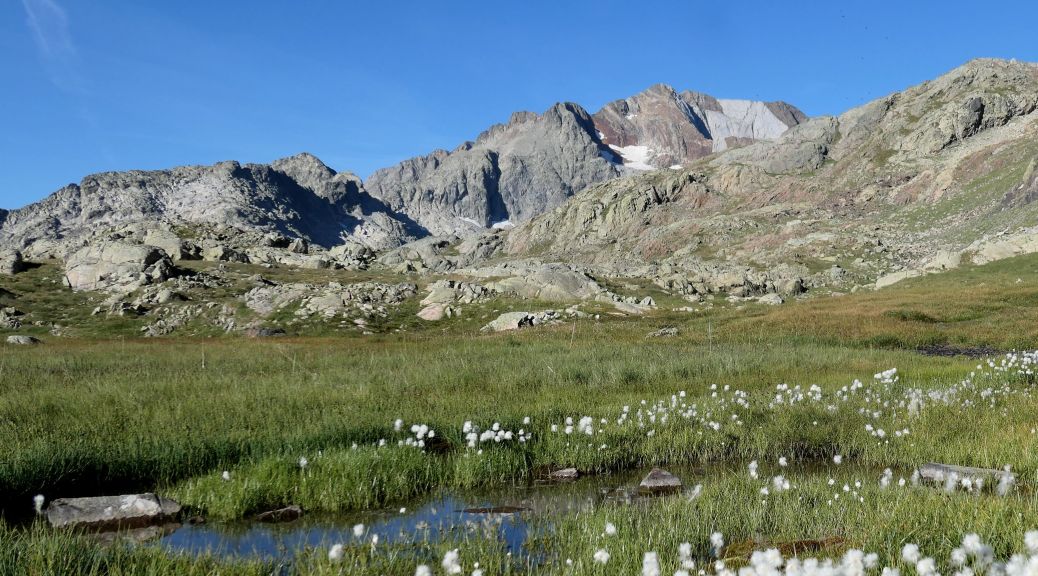
Or how to connect two very touristic places by little-used paths (except for a few sectors), or even very wild. From Lourdes, the GR101 is very quickly in a medium-mountain environment. The way goes through the Val d’Azun, then a succession of lakes (Estaing, Ilhéou, Pourtet, Nère) up to the border. On the Spanish side, past the Bachimaña refuge, the path becomes very wild (sometimes unmarked) with several lakes and the Tendeñera massif before reaching Torla. For those who wish to walk on marked trails, it is possible to reach San Nicolás de Bujaruelo (then Torla) via the Arratille pass from the Marcadau valley or after the Bachimaña refuge by the GR11.
The others ways in Pyrenees described :
North-South trails on old cross-border paths, HRP, hike east-ouest entirely in Spain… are described in the page
See the page Hiking through Pyrenees

Useful information
Public transport :
Lourdes is very easy to access by public transport (plane, train). From Torla, bus to Sabiñanigo or Barbastro with Avanza. The other option is to go back to France, to Gavarnie via the port of Boucharo/Bujaruelo or via the Brèche de Roland (high mountain route). From Gavarnie, bus Lio to Lourdes.
Difficulties :
It is a high mountain course with several passes above 2,500 meters, therefore with unstable weather and snowfields that can remain late in the season. The majority of the route is on marked trails (markers or cairns) but some are very little used and short passages are unmarked. There are some steep descents (but no climbing and no need to use your hands). See the table below for more details.
Trail marks :
Apart from some short parts, the whole route is on marked trails but sometimes these are only rare cairns. Being able to follow your GPS track will therefore be necessary.
Protected natural areas:
Regional nature reserve of the massif Pibeste-Aoulhet
Pyrenees National Park
Lexicon :
Bivouac: wild camping, usually according to French regulation, in a small tent (where you can’t standing) and pitched only for the night.
Abri: shelter. It’s unclosed (no door, some with just a roof) quite similar to those on the Appalachian Trail.
Cabane: small hut or shelter. It has a door. Some “cabanes” are occupied in summer by shepherds and open the rest of the year.
Refuge non gardé : unattended hut. Unlike a simple “cabane”, usually there are beds with mats.
Refuge: hut. You sleep in dorms, they can provide meals. Some of them even have showers.
Gîte d’étape: It’s like a refuge (or hostel) but accessible by road. You sleep in dorms (some have also bedrooms), they can provide meals. You will find “gîtes d’étape” on the main hiking trails.
Accomodation and resupply :
See the table below with my stages, shelters, refuges and shops.
Resupply : between Lourdes and Torla, only one grocery store in Arrens.
Water : there is water regularly (springs, torrent or river).
Accomodation : It is possible to do this route without a tent, sleeping in guarded refuges, except at the end between the Bachimaña refuge and Torla (a shelter in the Tendeñera valley). On this last part, the other option is to go through the San Nicolás de Bujaruelo refuge.
Bivouac :
Regional nature reserve of the massif Pibeste-Aoulhet : bivouac authorized between 8 p.m. and 8 a.m.
Pyrenees National Park : bivouac authorized more than an hour’s walk from a road access, between 7 p.m. and 9 a.m.
Aragon: Wild camping is prohibited with fines provided for in the event of an infringement but this does not seem to concern bivouacking (it is for example authorized according to certain rules in the natural parks of the region)
Internet websites :
For all France, the site gites-refuges.com is useful for information on huts and “gîtes d’étape” and that Refuges.info for huts and shelters.
Specifically for the Pyrenees, the site Pyrenees-refuges.com is very complete on this massif. It’s possible to download the gps position of all the “cabanes” and “refuges”.
Maps :
For topographic maps of the French National Institute of Geography (IGN), see the website Geoportail.
With the website Brouter.de you can draw a GPS track following the existing ways and trails.
When I’m on my way, I’m using the Iphigénie application. With it, you can have offline IGN topographic maps (both for France and Spain). It’s also possible to send beacons of my position (if there is network); this can be reassuring on certain occasions.
GPS track :
For each stage, see important information below. Attention ! The trace below was redesigned when I get back. In all cases, the reality on the ground should be privileged. If passing through private land, ensure permission from the owner.
Link to download the GPS track:

The stages
| Lourdes – Ordesa | Km | Cumul km | D+ | Info |
| Lourdes | 0 | Tous services | ||
| Col du Prat Rey | 13 | 13 | 850 | Cabane |
| Col d’Andorre | 3 | 16 | 260 | Cabane |
| Vallée du Bergons | 5 | 21 | 110 | À 2km en amont Refuge du Haugarou Tél. 0562972504 |
| Aucun | 6 | 27 | 340 | Camping Azun Nature Tél. 0562974505 – Camping Cap Pyrénées Tél. 0562974262 – Hôtel Le Picors Tél. 0975743948 |
| Arrens-Marsous | 2 | 29 | 10 | Camping Le Gerrit Tél. 0677970766 – Camping du Moulian Tél. 0786158255 – Camping Mialanne Tél. 0562926714 / 05 62 97 43 06 – Camping La Hèche Tél. 0562970264 – Camping GCU Tél. 05 62 97 43 06 – épicerie à Arrens |
| 1 Lourdes – Marsous | Par le GR101 (avec quelques petites variantes). Bon balisage. Rapidement dans des paysages de moyenne montagne. | |||
| Col des Bordères | 2 | 31 | 330 | Auberge Le Pic de Pan Tél. 0562974535 |
| Estaing | 3 | 34 | 10 | Camping Pyrénées Natura Tél. 0649518819 – |
| Les Viellettes | 2 | 36 | 80 | Gîte d’étape Les Viellettes Tél. 05 62 33 16 33 |
| Lac d’Estaing | 3 | 39 | 140 | Camping Tél. 0562972446 |
| Lac d’Ilheou | 8 | 47 | 1 100 | Refuge d’lheou Tél.06 79 08 20 64 |
| Vallon de Marcadau | 10 | 57 | 660 | Refuge Wallon Marcadau Tél. 0988773790 |
| 2 Marsous – Marcadau | Sentier balisé pour rejoindre le GR10 au col des Bordères et ensuite sur le GR jusqu’au refuge d’Ilhéou. Sentier balisé ensuite jusqu’au vallon de Marcadou. Belle étape de montagne avec plusieurs lacs. Du refuge Wallon, possibilité de rejoindre San Nicolás de Bujaruelo puis Torla par le col d’Arratille (itinéraire plus facile et moins sauvage que celui proposé) | |||
| Lac de Bachimaña | 7 | 64 | 700 | |
| Refugio de Bachimaña | 3 | 67 | 80 | Refugio de Bachimaña Tél.+34 697126967 |
| Ibón de Brazato | 5 | 72 | 290 | Petite cabane avant et au lac |
| Cabane del Puerto Tendeñera | 9 | 81 | 760 | |
| 3 Marcadau – Cabane de la Tendeñera | Sentier balisé par le port de Marcadau pour rejoindre le refuge de Bachimaña puis toujours avec balisage et en partie à flanc au-dessus des Baños de Panticosa le long d’une canalisation jusqu’au GR11 (possibilité de rejoindre San Nicolás de Bujaruelo par un chemin plus fréquenté que la suite). La suite est sur des sentiers sauvages. Le balisage est plus léger. Trois descentes raides entre l’Ibón de Brazato et le vallon sous la Tendeñera. Toujours des beaux paysages de montagnes avec des lacs | |||
| Torla | 17 | 98 | 880 | Camping Ordesa Tél.+34 974117721 – Camping Rio Ara Ordesa Tél.+34 974486248 – Refugio LucienBriet Tél.+34 699921587 – Hostal Alto Aragon Tél.+34 974486172 – Albergue Monte Perdido Tél.+34 616706821 – Hotel Casa Lordan Tél.+34 974486423 – Hotel Ballarín Tél.+34 974486155 – commerces |
| 4 Cabane de la Tendeñera – Torla | Montée vers la Tendeñera par un sentier balisé. Je ne suis pas passé par le sommet mais plus directement par un col puis une vire empierrée. Descente d’abord balisée puis à travers prairies et vagues sentiers (non balisés). Descente sur Torla par le sentier balisé PR-HU 135 Camino de Laor. De très belles vues sur cet itinéraire sauvage. | |||
| 98 | 98 | 6 600 | ||
 Thru hikes in Europe, Asia, USA...